
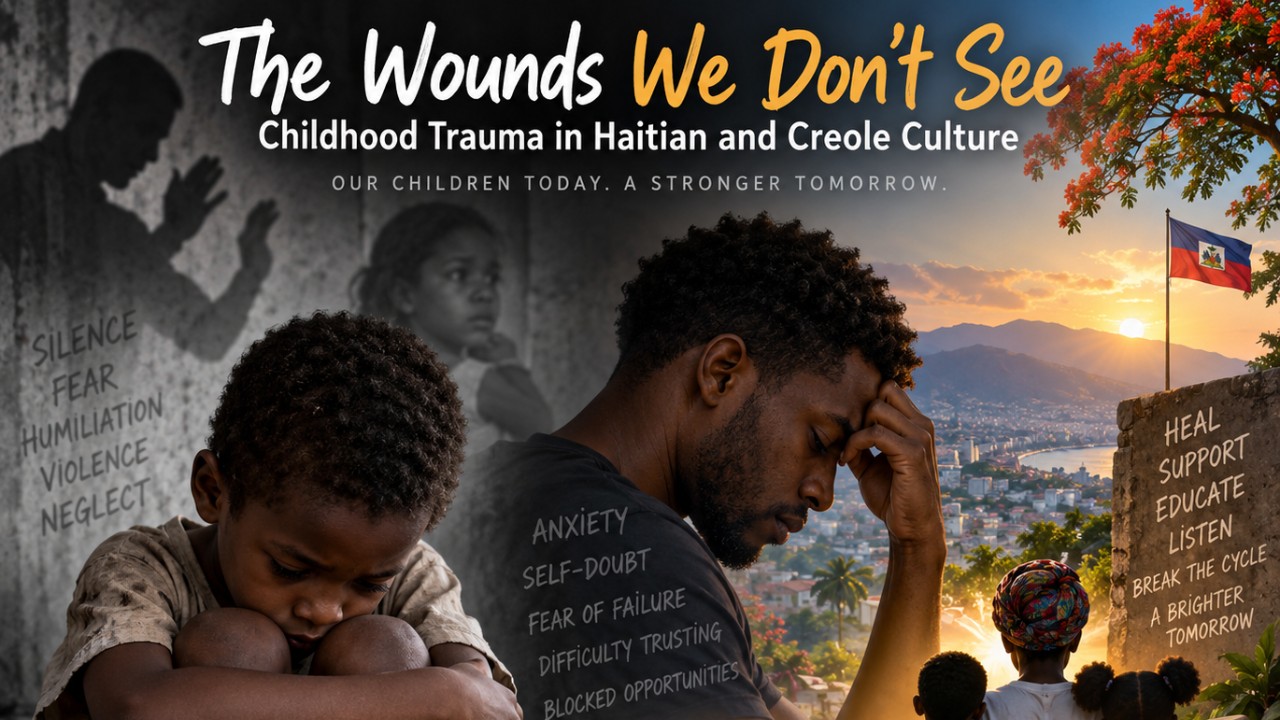
The Wounds We Don’t See: Childhood Trauma in Haitian and Creole Culture
In Haitian culture, we often speak proudly about strength.
“Fòk ou fò.” — You have to be strong.
Our parents and grandparents survived poverty, political instability, migration, natural disasters, violence and enormous uncertainty. That strength is part of our history. It has helped Haitian families survive circumstances that might have destroyed others.
But sometimes, our definition of strength has also taught children to suffer quietly.
A child gets hit and is told to stop crying. A young person is constantly insulted and told it is discipline. A child witnesses violence at home but nobody asks what they saw or how they feel. Another grows up afraid of making mistakes because mistakes are followed by humiliation or punishment.
The child learns to survive.
But what happens when that child becomes an adult?
When Childhood Fear Becomes Adult Fear
Trauma does not always look dramatic.
Sometimes it appears years later as fear.
Fear of failing. Fear of speaking. Fear of authority. Fear of rejection. Fear of taking risks. Fear of trusting someone. Fear of leaving an unhealthy relationship. Even fear of succeeding.
Imagine a child who grows up being severely punished every time they make a mistake. Eventually, that child may learn:
“If I make a mistake, something bad will happen.”
At eight years old, staying quiet might protect that child.
At thirty years old, however, the same instinct can become a barrier.
An opportunity appears, but the person doesn't apply.
They have a business idea, but never start it.
They want to speak during a meeting but remain silent.
They stay in situations that make them unhappy because uncertainty feels more frightening than familiarity.
From the outside, people may say:
“Li pa gen anbisyon.” — They have no ambition.
But sometimes what looks like a lack of ambition may actually be fear that has been carried since childhood.
Haiti: When Personal Trauma Meets Collective Trauma
For Haitian children, the conversation becomes even more complicated.
Trauma may not come only from inside the home. Children have lived through earthquakes, hurricanes, political instability, displacement, poverty, gang violence, kidnappings and the loss or separation of family members.
A child may therefore carry both personal trauma and the trauma of the environment around them.
Yet emotional survival is rarely discussed with the same urgency as physical survival.
When food, housing and security are uncertain, asking a child “How are you feeling?” can understandably seem less urgent than asking “Did you eat?”
But both questions matter.
A child can be physically alive while emotionally struggling.
“We Went Through It and We Turned Out Fine”
One of the most difficult conversations within families begins with a familiar argument:
“My parents disciplined me like that, and I turned out fine.”
This deserves compassion rather than condemnation.
Many Haitian parents raised their children using what they themselves were taught. Their parents learned from another generation, and that generation learned from the one before it.
Pain can travel through families without anyone intentionally deciding to pass it along.
A father who was never allowed to cry may have difficulty comforting his son.
A mother who grew up believing that harsh punishment creates successful children may repeat it because she genuinely believes she is preparing her child for the world.
Understanding this does not mean accepting abuse.,
It means recognizing that breaking generational trauma requires more than blaming the previous generation.
We have to give the next generation different tools.
But Who Do You Talk To?
This is where Haiti and many Creole communities face another challenge.
In places where psychological services are limited, expensive, stigmatized or simply unfamiliar, telling everyone to “go to therapy” is not a realistic solution.
For some people, even the word psychologist creates resistance.
So perhaps mental-health support should not always begin inside a psychologist's office.
It can begin inside the places people already trust.
The family. The school. The church. The doctor's office. The community center. The radio station.
Teachers can learn to recognize when a child's aggression, silence or poor concentration may be connected to something happening outside the classroom.
Parents can learn forms of discipline that establish boundaries without humiliation or violence.
Doctors and nurses can ask simple questions about emotional well-being during ordinary medical visits.
Churches can create conversations about emotional suffering alongside spiritual support.
Community organizations can train trusted adults to listen, recognize warning signs and know when professional intervention is necessary.
And Haitian media can play an enormous role.
Our Culture Can Be Part of the Solution
Haitians have always used storytelling to understand life.
We have music.
We have radio.
We have proverbs.
We have lakou conversations.
We have churches.
We have humor.
We have extraordinary traditions of community and family.
These cultural tools can become part of the mental-health conversation.
Imagine hearing respected Haitian musicians, athletes, doctors, teachers and community leaders openly discussing fear, childhood experiences and healing in Creole.
Imagine a radio program where parents can anonymously ask:
“Was what happened to me as a child normal?”
Imagine short Creole videos explaining why a traumatized child may become aggressive, withdrawn or afraid.
Imagine teaching children that saying “Mwen pè” — “I'm afraid” does not make them weak.
Mental-health education does not have to be imported into Haitian culture.
It can be expressed through Haitian culture.
Breaking the Cycle
This conversation is not about portraying Haitian parents as abusive.
It is not about rejecting discipline.
And it is certainly not about presenting Haitian or Creole culture as damaged.
It is about asking ourselves a harder question:
What should we keep from previous generations, and what should we change?
We should keep the resilience.
Keep the community.
Keep the respect for family.
Keep the music, spirituality, humor, storytelling and extraordinary ability to survive.
But perhaps we can leave behind the idea that children must suffer silently to become strong adults.
Because sometimes the child who appears strong is simply learning how to hide pain.
And eventually that child grows up.
The body gets bigger.
The responsibilities change.
But the fear can remain.
Our responsibility as a community should not simply be to raise children who can survive difficult childhoods.
It should be to raise children who become adults who are free enough to dream, speak, trust, take chances, build relationships and pursue opportunities without constantly fighting fears created years earlier.
Breaking generational trauma does not mean abandoning our culture.
It means allowing our culture to evolve so the next generation can inherit our strength without also having to inherit our pain.