Creole Cultures Around the World: One History, Many Peoples
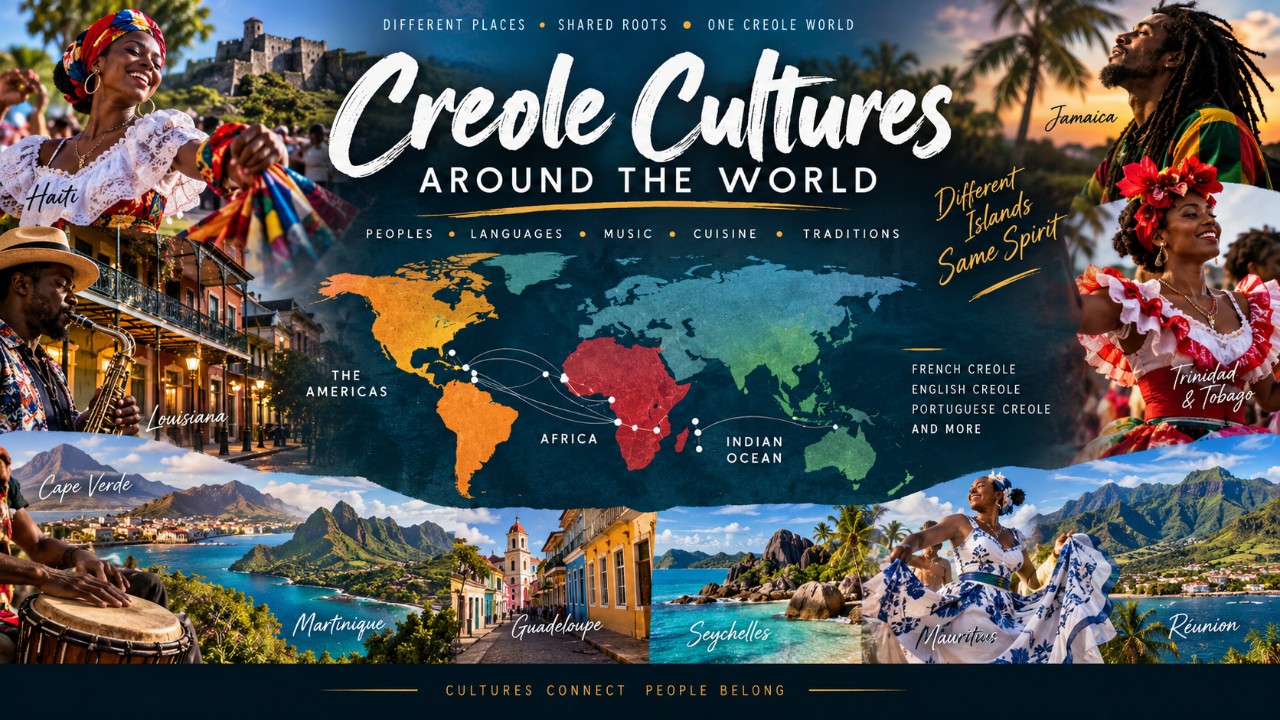
Creole culture exists across several continents, from the Caribbean and the Americas to West Africa and the Indian Ocean. Yet there is no single Creole culture or Creole people. Each community developed within its own historical circumstances, creating distinct languages, music, cuisine, traditions, beliefs, and identities.
What connects these communities is a broader history of cultural contact and transformation. European colonization, the forced migration of enslaved Africans, Indigenous societies, migration from Asia and other parts of the world, trade, resistance, and generations of cultural exchange all contributed—although in very different ways from one region to another—to the development of Creole societies.
Today, Creole cultures can be found in countries and territories associated with French-, English-, Portuguese-, and other language traditions.
The French-Based Creole World
Haiti
Haiti is home to one of the world's largest and most influential Creole-speaking populations. Haitian Creole, or Kreyòl Ayisyen, is an official language alongside French and is spoken throughout Haitian society.
Haitian culture was profoundly shaped by African peoples brought to Saint-Domingue during the colonial period, as well as European and Caribbean influences. Following the Haitian Revolution and independence in 1804, Haiti became the first independent Black republic of the modern era.
Language is only one expression of Haiti's Creole identity. Music such as kompa, rara, twoubadou, and mizik rasin, religious and spiritual traditions, storytelling, visual arts, dance, and cuisine all contribute to a distinctive Haitian culture.
Foods such as griot, diri djon djon, soup joumou, bannann peze, and pikliz have also become recognizable symbols of Haitian identity.
Martinique
Martinique is a French Caribbean island where French and Martinican Creole (Kréyol Matinik) coexist.
Its culture reflects African, European, Caribbean, and later Asian influences. Music and dance traditions such as bèlè, along with zouk, literature, cuisine, carnival, and storytelling, remain important expressions of Martinican identity.
Martinique is not an independent country; it is an overseas department and region of France.
Guadeloupe
Like Martinique, Guadeloupe is politically part of France while maintaining a strong Creole cultural identity.
Guadeloupean Creole (Kréyòl Gwadloup) is widely used alongside French. One of Guadeloupe's most important cultural traditions is gwoka, a combination of drumming, singing, and dancing deeply connected to the history and experiences of Guadeloupe's African-descended population.
Cuisine, carnival, oral traditions, and family customs further distinguish Guadeloupean Creole culture.
Dominica
Dominica demonstrates how political language and cultural language do not always follow the same boundaries.
English is the country's official language, but Dominican Kwéyòl, a French-lexifier Creole, remains an important part of the island's cultural heritage.
Dominican culture combines African, French, British, and Indigenous Kalinago influences. Music, traditional foods, dance, storytelling, and celebrations continue to preserve this multicultural history.
Saint Lucia
Saint Lucia is another English-speaking Caribbean nation with significant French-Creole heritage.
Saint Lucian Kwéyòl remains an important expression of identity despite English being the country's official language. Traditional storytelling, music, cuisine, dance, and celebrations such as Jounen Kwéyòl help maintain the language and culture.
Grenada
Grenada's culture reflects African, European, and wider Caribbean influences.
Although English and local English-based Creole varieties dominate today, the island also has historical French-Creole influences. These different layers of history can be seen in Grenadian food, carnival, folklore, music, place names, and community traditions.
Trinidad and Tobago
Trinidad and Tobago represents one of the Caribbean's most culturally diverse societies.
African, European, Indian, Chinese, Indigenous, Middle Eastern, and other communities contributed to the country's development. English-based Creole varieties are widely spoken, while French Creole also played an important historical role.
Carnival, calypso, soca, steelpan, chutney music, dance, and cuisine demonstrate how cultural traditions from different communities have interacted and evolved over generations.
United States — Louisiana
Louisiana developed one of North America's best-known Creole cultures, particularly in New Orleans and southern Louisiana.
Louisiana Creole identity emerged from interactions among people of African, French, Spanish, Caribbean, Indigenous, and other backgrounds.
Its cultural legacy can be found in Louisiana Creole language, cuisine, architecture, Catholic traditions, music, dance, and celebrations.
Louisiana Creole and Cajun cultures have influenced each other considerably, but they are not interchangeable and have different historical origins.
The Indian Ocean Creole World
Mauritius
Mauritius developed an exceptionally diverse society through centuries of migration and colonial history involving African and Malagasy peoples, Europeans, Indians, Chinese, and other communities.
Kreol Morisien, or Mauritian Creole, became the principal everyday language connecting much of the population.
One of the island's most recognizable cultural expressions is sega, a musical and dance tradition with strong African and Malagasy roots. Mauritian cuisine similarly combines African, European, Indian, and Chinese influences.
Seychelles
In Seychelles, Creole identity occupies a central place in national culture.
Kreol Seselwa is one of the country's official languages. Seychellois society developed through African, European, Malagasy, and Asian influences within the distinctive environment of the Indian Ocean.
Traditional moutya and sega, seafood and coconut-based cuisine, storytelling, dance, and festivals remain important expressions of Seychellois heritage.
Réunion
Réunion is a French island in the Indian Ocean with a population shaped by migration from Africa, Madagascar, Europe, India, China, and elsewhere.
Réunion Creole (Kréol Réyoné) is widely spoken alongside French.
One of Réunion's most significant cultural traditions is maloya, a musical and dance tradition with deep connections to the experiences of enslaved people and their descendants. Sega is another important part of the island's musical heritage.
The Portuguese-Based Creole World
Cape Verde
Cape Verde is home to one of the world's most important Portuguese-based Creole cultures.
The islands' society developed following Portuguese settlement and the forced migration of Africans beginning in the fifteenth century. Over generations, these populations created a distinctive Cape Verdean identity.
Kriolu, or Kabuverdianu, became the principal language of everyday life and an important symbol of national identity.
Music occupies an especially important position in Cape Verdean culture. Morna, coladeira, funaná, and batuque express themes ranging from love and celebration to migration and sodade—a profound sense of longing or nostalgia.
Guinea-Bissau
Guinea-Bissau Kriol developed through historical contact between Portuguese and West African peoples.
Portuguese is the country's official language, while Kriol serves as an important language of communication among people from different ethnic and linguistic communities.
Music, oral traditions, dance, and cuisine demonstrate the interaction between local West African heritage and centuries of Atlantic cultural exchange.
São Tomé and Príncipe
São Tomé and Príncipe has a particularly rich collection of Portuguese-lexifier Creole languages.
Its Creole societies developed through Portuguese colonization, plantation economies, and the forced migration of African populations.
Languages such as Forro, Angolar, and Lung'ie preserve different parts of this complex history. Music, dance, cuisine, religious practices, and oral traditions continue to reflect the islands' strong African foundations.
Equatorial Guinea — Annobón
The island of Annobón provides another important example of Portuguese-derived Creole heritage.
Although Equatorial Guinea is predominantly Spanish-speaking, Fa d'Ambô developed on Annobón from historical contact between Portuguese and African languages.
This makes Annobón an important part of the broader Gulf of Guinea Creole story, even though Creole culture does not characterize Equatorial Guinea as a whole.
The English-Based Creole World
Jamaica
Jamaica is home to one of the world's most internationally influential English-lexifier Creole varieties.
Jamaican Patwa developed primarily through contact between English and West African languages during the colonial and slavery periods, with additional influences over time.
Jamaican language and culture became globally influential through reggae, dancehall, dub, Rastafari-associated cultural expressions, cuisine, literature, and popular culture.
Jamaican Creole should not be considered incorrect or "broken" English. It has its own systematic grammatical structures and long cultural history.
Belize
Belize is a Central American country culturally connected to both the Caribbean and mainland Central America.
Belizean Kriol is widely spoken and understood and often functions as a shared language among people from different backgrounds.
African, European, Maya, Garifuna, Mestizo, and other communities have all contributed to modern Belizean society, producing a remarkably diverse cultural landscape.
Guyana
Guyana is geographically South American but maintains strong historical and cultural connections with the Caribbean.
Guyanese Creole is an English-lexifier Creole widely used in everyday communication.
African, Indigenous, Indian, European, Chinese, and Portuguese communities have all contributed to Guyanese society. Its cuisine, festivals, language, music, and religious traditions reflect this diversity.
Suriname
Suriname is one of the most linguistically diverse countries associated with the wider Creole world.
Sranan Tongo developed as an important Creole language and lingua franca. Maroon communities also developed languages such as Ndyuka and Saramaccan.
African, Indigenous, Dutch, Indian, Javanese, Chinese, Jewish, and other communities contributed to Suriname's extraordinary cultural diversity.
The Bahamas
Bahamian culture combines strong African heritage with British and broader Caribbean influences.
Local English-based Creole speech, Junkanoo, music, folklore, cuisine, and community traditions have developed into a recognizable Bahamian cultural identity.
Antigua and Barbuda
Antigua and Barbuda has a strong Afro-Caribbean cultural foundation shaped by its colonial history.
Local English-based Creole speech, carnival, music, food, storytelling, and community customs remain important expressions of Antiguan and Barbudan identity.
Saint Kitts and Nevis
Saint Kitts and Nevis developed a distinctive Caribbean culture through African heritage and centuries of European colonial rule.
English-based Creole speech is part of everyday communication, while carnival, music, cuisine, storytelling, and family traditions continue to preserve the islands' cultural heritage.
Saint Vincent and the Grenadines
Saint Vincent and the Grenadines combines African, Indigenous Caribbean, European, and wider regional influences.
English is the official language, while local English-based Creole varieties are commonly used. Carnival, music, food, dance, and oral traditions contribute to a distinctive Vincentian identity.
Creole Cultures Beyond English, French, and Portuguese
The global Creole story does not end with these three linguistic traditions.
Aruba, Curaçao, and Bonaire, for example, are home to Papiamento/Papiamentu, a Creole language shaped by Iberian, African, Dutch, and other influences.
The Pacific also contains important contact languages and Creole traditions, including Bislama in Vanuatu, Tok Pisin in Papua New Guinea, and Solomon Islands Pijin.
These examples demonstrate why the Creole world cannot be represented by one language family or one region.
One Creole World, Many Identities
There is no single Creole ethnicity, language, cuisine, religion, or historical experience.
A Haitian speaking Kreyòl, a Cape Verdean speaking Kriolu, a Jamaican speaking Patwa, a Mauritian speaking Kreol Morisien, and a Seychellois speaking Kreol Seselwa belong to distinct societies with their own histories.
What connects these communities is something broader: the creation of new cultures through encounters among peoples who brought different languages, traditions, beliefs, foods, rhythms, and ways of life.
Sometimes those encounters occurred through migration and trade. Others resulted from colonization, slavery, forced displacement, and systems of inequality. Creole cultures emerged not simply because different cultures "mixed," but because generations of people adapted, resisted, preserved, transformed, and created.
That process produced some of the world's most dynamic cultural traditions.
From Port-au-Prince to New Orleans, Kingston to Praia, Pointe-à-Pitre to Port Louis, and the Caribbean Sea to the Indian Ocean, the Creole world demonstrates that shared historical processes can produce extraordinarily different identities.
Creole culture is not one culture repeated around the world. It is a family of distinct cultures—each carrying its own history, language, creativity, and voice.